AGI & ASI Future Scenarios · 02
Humanity Connected—and Did Not Remain One Species
At first, glasses revealed information we could not see and neural prostheses restored words that had been lost. But if perception, memory, and judgment come to depend on external computation—and access is concentrated among a few—will augmented humans become freer, or split into different species and classes?
Watch the scenario
Korean audio · English subtitles · 30 seconds · 720p
An AI-generated dramatization of this fictional story. Korean audio with English subtitles.
 Enlarge illustration +
 The Story
The Birth of Hybrid Humanity
- 01Connected to the present
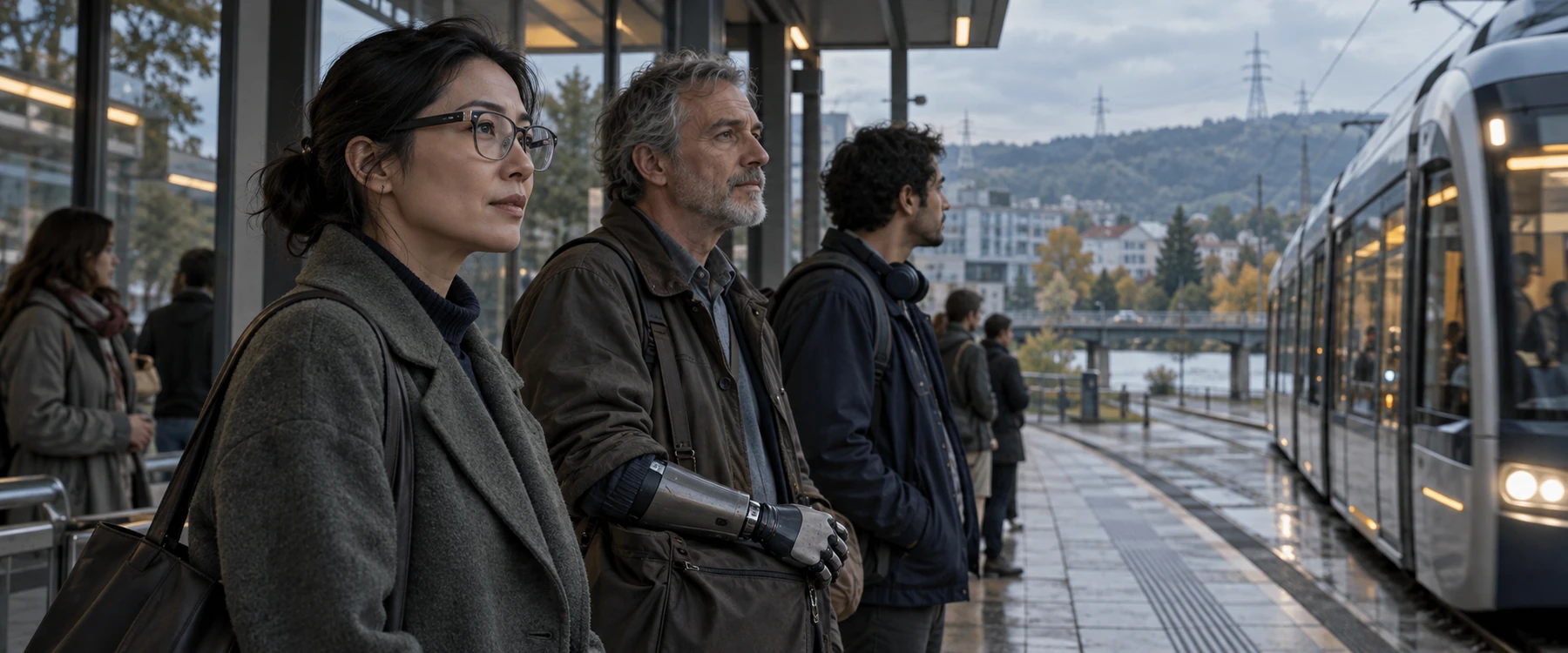
Machine senses beyond the five
AR and MR glasses and wearable sensors overlay distance, language, heat, health, and context in real time. Some information is processed by an on-device NPU; larger inferences come from data centers. People gain a new sensory channel, but it is tethered to batteries, networks, and provider servers.
 Enlarge illustration +
 Glasses assist everyday perception, supported by computation and connectivity. - 02In clinical research
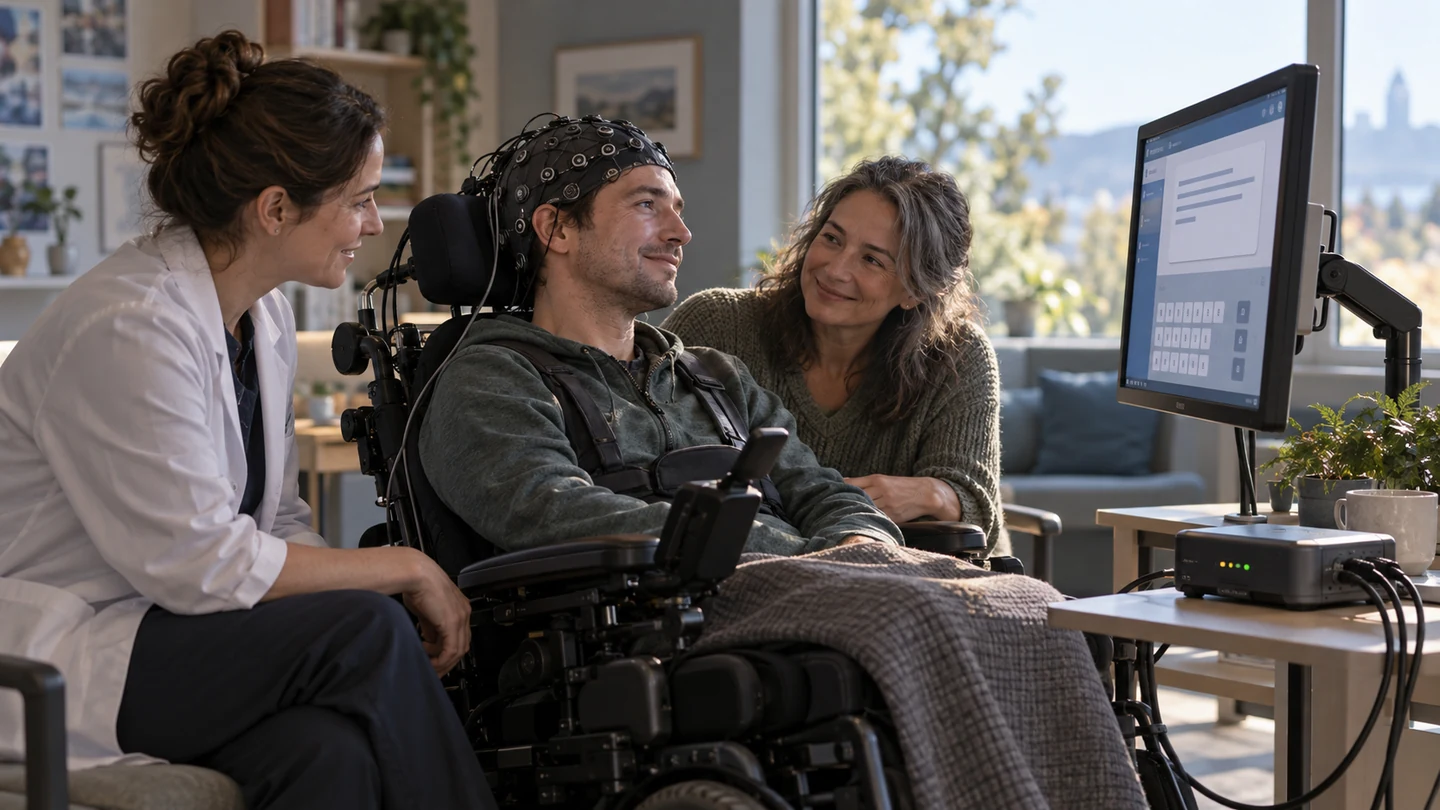
Connections that restore what was lost
Neural prostheses and brain–computer interfaces read intent from people with paralysis, turn it into text and speech, and control mechanical limbs or avatars. The technology is first embraced not as a loss of humanity, but as a means to restore communication and autonomy.
 Enlarge illustration +
 Connection first restores communication and autonomy. An imagined research setting. - 03Plausible development
From treatment to elective replacement
As artificial limbs, eyes, organs, and senses become more precise and durable, replacement moves beyond therapy into enhancement. Some people replace much of the body, while performance and lifespan depend on a manufacturer's software, parts, and subscription policy.
 Enlarge illustration +
 More choices for the body also raise questions about maintenance and repair. - 04Unverified assumption
The brain becomes a platform
Read interfaces are joined by write interfaces that exchange cues about attention, emotion, and memory with AI. The most intimate signals become inputs for model training and prediction, blurring where a person's judgment ends and a suggested thought begins.
 Enlarge illustration +
 Who decides how far to connect? A conjecture about neural influence and judgment. - 05Plausible social path
Intelligence on loan
People summon languages, specialist knowledge, working memory, and decision support when needed. Intelligence becomes both a personal capacity and a compute service. As more abilities vanish when power, connectivity, or payment stops, autonomy becomes conditional on a service contract.
 Enlarge illustration +
 When a service stops, which abilities and choices remain ours? - 06Pure speculation
Thought beyond the individual
Consensually shared memories and sensations make collaboration faster than speech. Connected groups think through one problem at once, and individuals feel like parts of a larger self. Yet it becomes difficult to locate withdrawal of consent, ownership of memory, and personal responsibility.
 Enlarge illustration +
 Imagined shared thought must include a right to disconnect. A collective self remains unverified. - 07Systemic risk
A caste built from power and compute
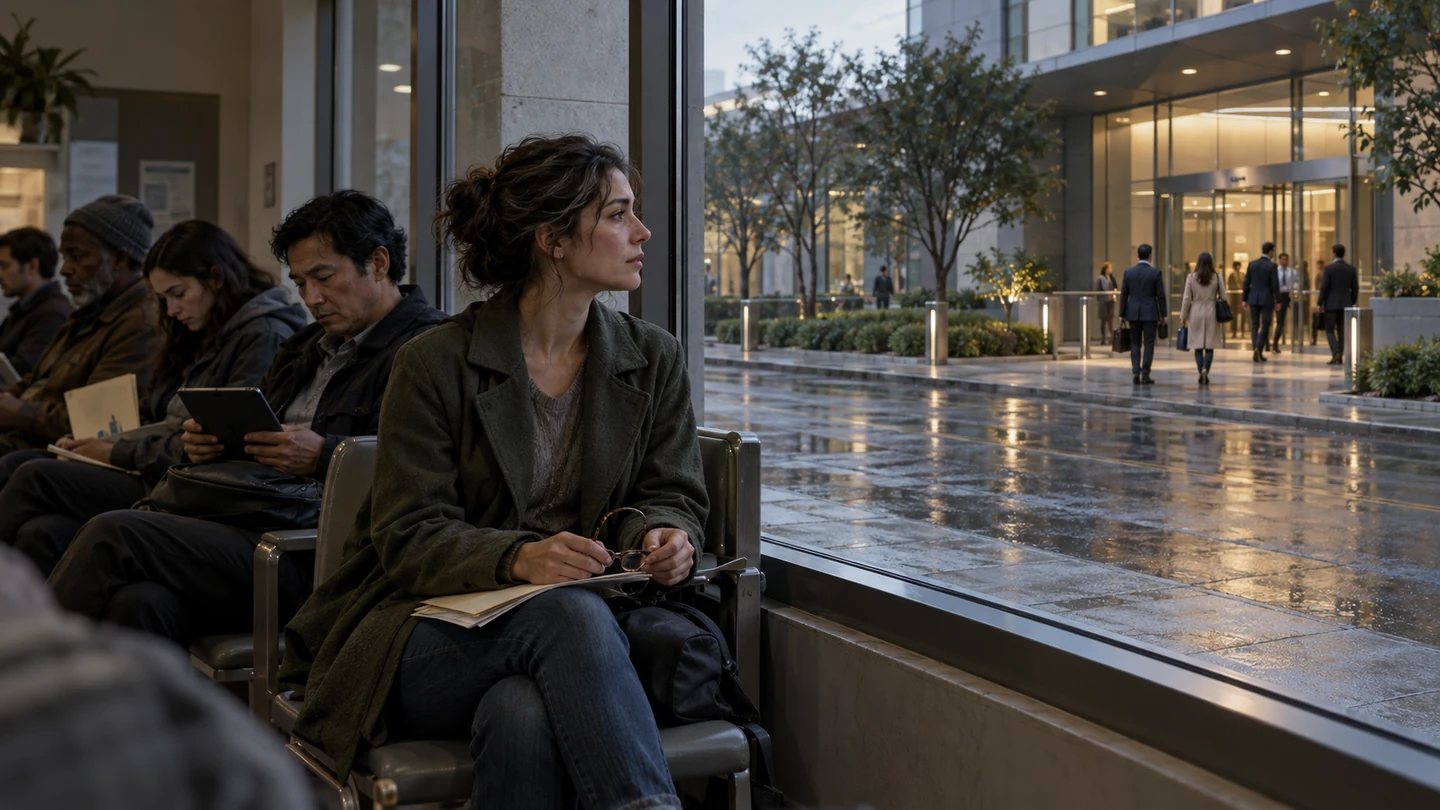
Those controlling the most electricity, chips, models, and neural data learn faster, work longer, and predict markets and policy. A small augmented class becomes dominant, while others provide low-authority labor or disappear from the economy. Knowledge inequality replicates faster than wealth inequality.
 Enlarge illustration +
 A widening gap between those who wait for computation and those who enter freely. - 08Extreme assumption
The boundary where one humanity ends
People who preserve biological bodies and independent selves, those who replace much of the body, and networked humans who share thought demand different rules for life. In conflict over who receives human rights and resources, humanity does not become extinct—but loses the shared sense that it is one species.
 Enlarge illustration +
 Can different bodies and ways of thinking share equal rights? Speciation is an extreme assumption.
Intervention Points
The danger is not changing the body. It is who holds the keys to the changed body and mind.
The benefits of augmentation can be protected while these rights and infrastructures are designed now.
Mental self-determination
Treat neural data and stimulation as the most sensitive personal information, separate permission to read, infer, and write, and guarantee explicit consent that can always be withdrawn.
A right to remain unaugmented
Do not make augmentation a de facto requirement in education, work, insurance, or public services. Citizenship and basic opportunity must not depend on using a device.
Ownership of body and memory
Require safe offline operation, data portability, independent repair, and interoperability so basic function survives device failure or a provider's collapse.
Public access to power and compute
Combine competition policy, public infrastructure, and universal-access standards so the physical basis of cognitive capability cannot be monopolized by a small group.
Evidence Boundary
Where observation ends and imagination begins
XR, on-device AI, and neural prostheses
Machines already overlay sensory information, decode intended speech from neural activity, and control prostheses and avatars. These systems remain far from general thought-reading or intelligence uploading.
Neural data, platform dependence, and access gaps
Privacy, autonomy, safety, and equity around brain and nervous-system data are active policy issues. Concentration of AI computation in capital- and power-intensive data centers is also observable.
Whole-brain replacement, collective selves, and speciation
There is no evidence that personal memory or consciousness can be transferred into a machine, that people can form one self, or that augmentation will create a distinct species. These stages ask what today's rights might prevent or enable over the long term.
Research Context
Sources for separating the thought experiment from present evidence
Nature · A high-performance speech neuroprosthesis
A clinical study decoded attempted speech from intracortical arrays into sentences from a large vocabulary, illustrating today's limited, restorative role for BCIs.
Read the sourceUNESCO · Recommendation on the Ethics of Neurotechnology
The international framework adopted in 2025 treats mental privacy, identity, autonomy, and unequal access to neurotechnology as human-rights concerns.
Read the sourceOECD · Neurotechnology
Reviews the medical promise of technologies that access or influence the brain and nervous system, alongside safety, transparency, accountability, equity, and trust across their lifecycle.
Read the sourceIEA · Energy and AI update
Tracks rapid growth in electricity demand from AI-focused data centers and infrastructure investment, grounding the physical limits behind any future cognitive service.
Read the sourceThe question is not whether people should put machines into their bodies. It is who owns expanded perception and memory, whether a person can refuse connection and remain equal, and whether the self survives when the power goes out.
Scenario Archive
Compare another path into the future.
Each scenario follows a different technology, but returns to the same question: when and where do people surrender meaningful control?